Your sales team has been working a target account for six weeks. Cold emails, a few LinkedIn touches, one demo that went quiet. Then on a call to debrief, someone mentions that your CFO went to business school with the prospect's VP of Sales. They have stayed in touch for years. Nobody knew. The connection was there the whole time, invisible in someone's personal contact history.
This happens because most CRMs are not built for account mapping. They track where a deal is, not who your team already knows within an account. An org chart CRM changes that. It maps the internal hierarchy of your key accounts alongside the relationships your team already has at each level, so you can see who knows who before you decide how to reach out.
Rolodex's Org Chart feature is built for exactly this. This article explains what it does, how teams use it, and why it changes how relationship-driven teams work their most important accounts.
What a standard CRM misses about account mapping
Most CRMs organize contacts around pipeline stages and deal values. That architecture answers one question: where is this deal? It does not answer the questions that matter before a deal is even open.
Who holds decision-making authority inside this account? Who are the gatekeepers? Which of your team members already has a relationship with the CFO, the VP of Engineering, or the board member on the investment committee? Standard CRMs are not designed to surface any of this.
This is the gap that organizational chart functionality fills. Account mapping means understanding not just who your contacts are, but where they sit in the hierarchy, who they report to, who holds influence, and which existing relationships your team can draw on to get a warm introduction rather than sending a cold message to someone who has never heard of you.
For teams doing enterprise sales, investor relations, business development, or recruiting, this visibility is often the difference between a deal that moves and one that stalls. Not because of the pitch, but because of how the first conversation started.
How Rolodex works as an org chart CRM
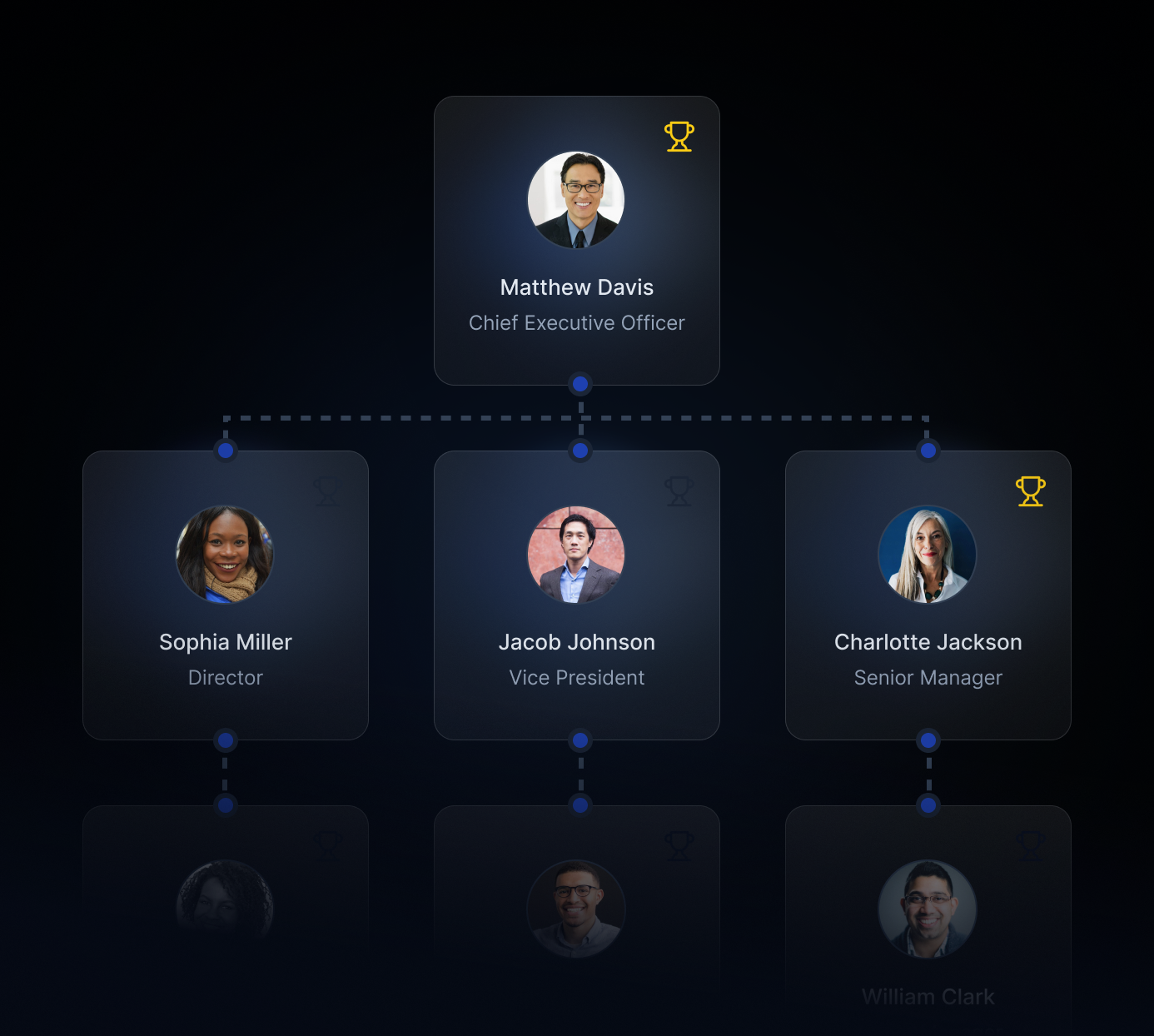
Rolodex builds the organizational chart of your key accounts automatically from the contacts your team already has. When team members connect their Gmail, Outlook, and LinkedIn accounts, Rolodex identifies which contacts belong to the same company and maps their relationships to each other.
Each contact in the account hierarchy shows:
Their role and seniority within the organization
Which team member owns the relationship
When the last touchpoint happened
Any notes or interaction history the team has logged
The org chart is shared across the whole workspace. Every team member can see who knows who within an account, not just the contacts they personally manage. When a new team member joins, they can see the full relationship history your team has built with that account from day one.
This is the difference between an org chart CRM and a standard contact database. A contact database tells you who exists. An organizational chart tells you where they sit, who connects to them, and which team member is best positioned to make the introduction.
Surface warm intro paths before reaching out cold
The most immediate use of account mapping is surfacing warm introduction paths before anyone sends a cold message.
Before a team member reaches out to a new contact at a target account, they check the org chart first. If a colleague already has a relationship with that contact, or with someone in their reporting chain, the right move is a warm introduction rather than cold outreach. Warm introductions get substantially higher response rates than cold messages, and they start the relationship from a place of credibility rather than zero context.
Without org chart visibility, these paths exist but stay invisible. Someone has to know to ask. The colleague with the relevant connection has to remember they have it. The timing has to work out. In practice, these introductions happen by accident when they happen at all.
With an org chart CRM, the process becomes systematic. The team does not guess who might know someone. They look at the account hierarchy, see which team members have relationships at each level, and identify the most direct path to the right person before any outreach happens.
Coordinate multi-threaded outreach across complex accounts
Complex deals require contact with multiple stakeholders at the same time. An enterprise sales cycle typically involves an economic buyer, a technical evaluator, an internal champion, a procurement lead, and several people who can quietly block the deal without ever appearing in the pipeline. Investor relations, recruiting, and large partnership deals have similar structures.
Multi-threaded outreach means different team members managing different relationships within the same account, all in parallel. The CFO conversation, the VP conversation, and the board member conversation happen simultaneously, each owned by the person with the strongest existing relationship at that level. You can see the full shape of these relationships in Rolodex across your entire network.
Without a shared org chart, this coordination happens through Slack threads and memory. Two people contact the same stakeholder in the same week without knowing. Nobody realizes a key decision-maker has been untouched for a month.
With org chart visibility in Rolodex, the team can see the full picture at once. Who owns which relationship in the account hierarchy. When each was last touched. Where the gaps are. Each team member knows what colleagues are working on without needing a daily sync.
Stakeholder mapping for sales, fundraising, and recruiting
The org chart CRM use case extends beyond traditional sales. Any team that needs to navigate complex organizational hierarchies benefits from stakeholder mapping.
For sales teams: Map the full buying committee on enterprise accounts. Identify internal champions and economic buyers before the deal enters a formal procurement process. Know which relationships are warm before the proposal goes in.
For investor relations and fundraising: Track who on your team knows which partners and managing directors at each fund. See the relationship history before a pitch meeting. Find the path to a warm introduction rather than a cold email to a managing partner.
For recruiting: Map the hiring managers, department heads, and executives at target companies. Use existing team relationships to get candidates in front of the right people faster.
For business development: Identify the decision-makers on partnership deals early. Map out who needs to be aligned on both sides before term sheet conversations start.
In all of these cases, the core problem is the same: relationships exist across your team's network that could accelerate the work, but they stay invisible because nobody has a shared view of who knows who inside each account.
Rolodex as a relationship intelligence platform for account-driven teams
Most CRM alternatives focus on making pipeline management lighter. Rolodex focuses on the relationship layer that sits underneath the pipeline.
As a relationship intelligence platform, Rolodex gives teams a shared view of their collective network alongside the organizational hierarchy of the accounts they care about most. The Org Chart feature takes the contacts your team has accumulated across individual inboxes, calendars, and LinkedIn accounts, and organizes them into a map of who sits where inside your key accounts.
The result is something a standard CRM does not give you: clarity about the relationship landscape inside an account before you start working it. Not after the deal is open. Before.
If your team is managing complex accounts, investor relationships, or multi-stakeholder deals without a shared view of who knows who inside each account, it is worth seeing what that visibility looks like in practice. Create your Rolodex workspace and set up your first account org chart in under 20 minutes, or book a demo to see how other teams are using it.