
David Rockefeller's Networking Strategy: What Still Works in 2026
In December 2017, the world got a rare peek at David Rockefeller's private contact system, a five-foot-tall, custom machine stuffed with index cards. Each card held a person; each person held a story: where they met, who introduced whom, what was promised, what to remember next time. Over 50+ years, Rockefeller logged contact information and notes on roughly 100,000 people across 200,000 cards, a living archive of relationships that powered his work in banking, philanthropy, and diplomacy.
The scale is hard to process. But the networking strategy behind it is simple: write things down, keep them current, and use the context before every conversation. That discipline, not the cabinet, is what made him legendary.
If you've ever felt overwhelmed keeping up with a few hundred contacts, his system sounds superhuman. It wasn't magic. It was meticulous process and a willingness to invest in relationships long before the payoff. The Wall Street Journal called the file "astonishing," and Forbes reported the cabinet stood about five feet high, cataloguing a global constellation of leaders, operators, and friends.
Today, the hard part isn't the cabinet. It's signal. We swim in email, LinkedIn updates, messages, and meetings, yet the context that made Rockefeller so effective still slips through the cracks. What Rockefeller had in a five-foot cabinet is what a digital rolodex delivers in a browser: shared, searchable, and maintained as a team. You no longer need decades of manual updates to get the same result.
What Rockefeller Actually Did, and Why It Worked
Rockefeller didn't collect business cards. He collected history. After nearly every interaction he'd log where, when, with whom, and what mattered, then reference it before the next touch so each conversation started warm.
A few details underscore the craft:
Volume with memory. Rockefeller's network was estimated at 100,000 people, with 200,000 index cards chronicling meetings, addresses, family details, and milestones.
Consistency. The cards weren't static. He crossed out outdated facts, appended fresh notes, and added press clippings, updating the file as lives changed.
Preparation. Before meetings, he scanned relevant cards to re-enter a relationship's context: names of spouses, last conversation, topics to revisit.
This was the original, analog relationship management: keep trustworthy context, use it to be more human, and let trust compound.
What James Wolfensohn observed
Former World Bank president James Wolfensohn was himself known for exceptional relationship-building across his 10-year tenure. He was one of the few people who had direct, repeated access to Rockefeller's contact system in practice, and his observation cuts to the heart of the networking strategy: "The system allowed Rockefeller to pick up as though he had seen you the week before, even if years had passed."
Wolfensohn understood what made that possible because he practiced something similar. The key was not charm or memory. It was structured contact management: capturing context at the time of each interaction, so the next one started with knowledge rather than reconstruction. The goal Wolfensohn described, picking up mid-conversation after years apart, is exactly what a good relationship management system makes possible at team scale.
Building a Digital Rolodex: The Rockefeller Method, Updated
If Rockefeller were operating today, he wouldn't build a cabinet. He'd spin up a Rolodex workspace and ask his team to connect email and LinkedIn. In a day, he'd have the bones of what took him decades: a single, shared view of everyone the team knows, and the context to act on it. Here's how the same professional networking principles translate, step by step.
How to build a shared contact database your team can search by relationship
Instead of cards, Rolodex pulls in contacts from email and LinkedIn, then deduplicates them into a single profile per person. Search by name, company, role, seniority, or location, then sort by who on your team knows them. You're not guessing who can open a door; you can see it.
Rockefeller's card for a head of state listed meetings and intermediaries. A Rolodex contact shows who on your team has met them, when, and what was said in notes, so you instantly know the warmest path to a conversation.
Want to mimic his geographic dividers? Use filters and Map View to visualize where your relationships cluster before a roadshow or conference trip.

How to log relationship context right after every meeting
Rockefeller's superpower was writing things down immediately. In Rolodex, you open the contact and add one clean note right after the call: the key decisions, risks, and next steps. If there's a deck, transcript, or follow-up plan, attach it. Next time anyone opens that contact, the Activity Feed tells the story in order, no inbox archaeology.
This is where most professional networking breaks down. The insight from the call lives in someone's head, or in a chat message that disappears. Structured contact management means the context is always where it needs to be.

How to follow up with contacts automatically without manual tracking
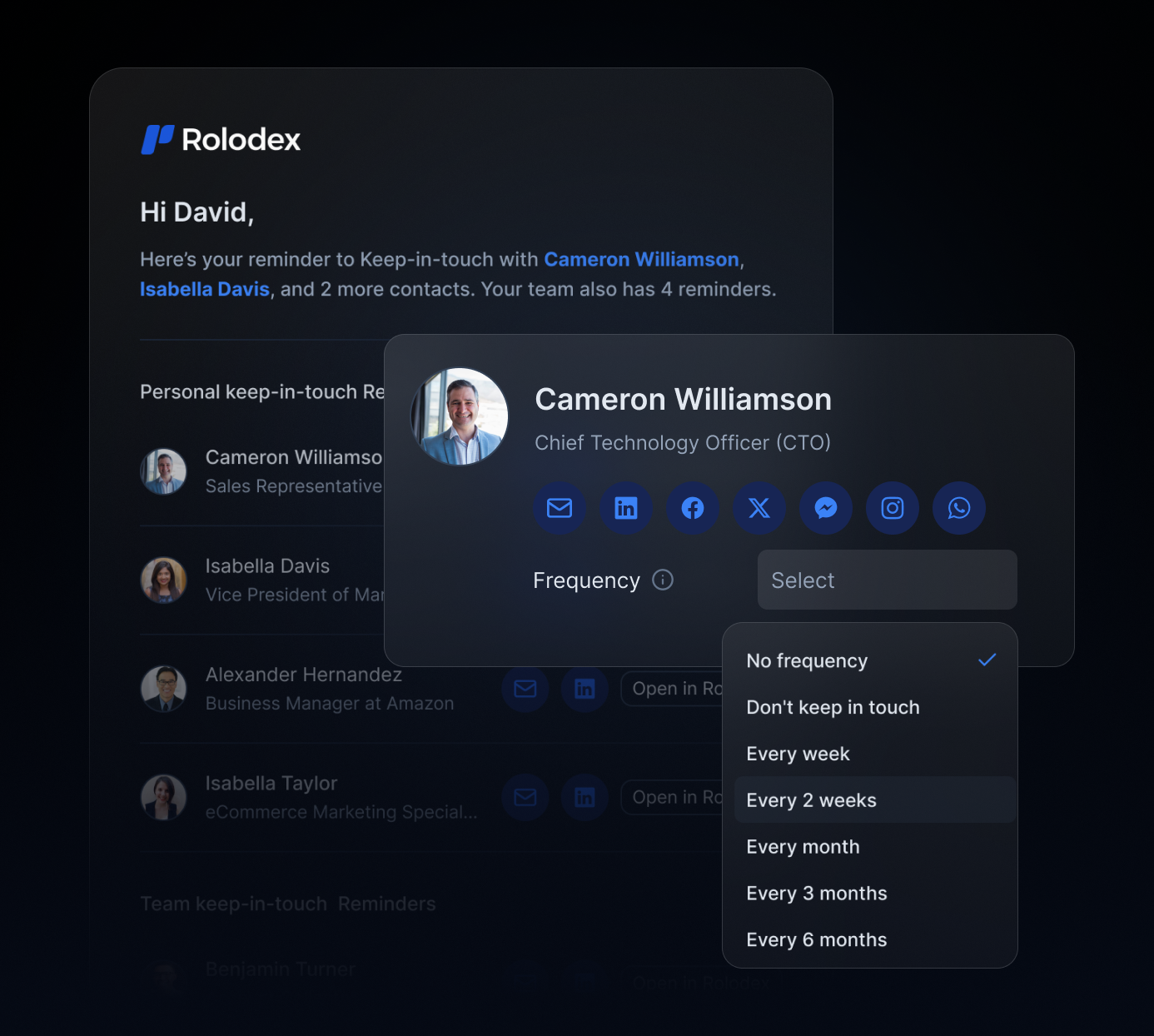
Rockefeller refreshed cards as lives changed. You do it with Keep in Touch reminders and Title Alerts:
Title Alerts notify you when someone in your network changes roles. That's the moment to congratulate them, or suggest a catch-up while the change is still fresh.
Keep in Touch reminders let you set a follow-up cadence for key relationships (quarterly for close contacts, biannual for advisors), so the relationship doesn't quietly decay when calendars get crowded.
This replaces the most labor-intensive part of Rockefeller's networking strategy with something you set once. The consistency he maintained manually is now automated, and rekindle-dormant-relationships covers exactly what to do when a relationship has already gone quiet.
How to manage warm introductions at team scale
Rockefeller's cards recorded who introduced whom. In Rolodex, you can request warm introductions through the teammate who actually knows the person, then track each ask in Boards View: Requested → Intro Sent → Meeting → Outcome. Fast follow-ups and closed-loop thank-yous stop intros from dying in the gaps.
This is the team-scale piece Rockefeller couldn't have had on his own. A shared digital rolodex means your team's full network of warm paths is visible to everyone, not locked in one person's inbox.
How to automate contact updates and meeting notes
Analog Rockefeller clipped newspapers; you pipe in structured context:
After a call, use an API to auto-attach the transcript to the contact profile, highlights searchable five minutes later.
Push CRM stage changes as notes, so sales and leadership share the same timeline without duplicate updates.
For recruiting, route ATS interview feedback to the contact automatically, so the hiring manager has the full picture in one place.
For teams building more automated workflows, the Rolodex MCP guide covers how to connect an AI assistant directly to your contact data.
A Quick Side-By-Side
Rockefeller's System | Rolodex |
|---|---|
Five-foot cabinet; 200,000 index cards | One shared workspace; unified profiles |
Typed notes and clippings after meetings | Notes and attachments logged in seconds |
Scan cards before meetings | Open a contact and read the Activity Feed |
Geographic tabs and cross-references | Filters and Map View by city or region |
Manual updates for promotions and new roles | Title Alerts detect changes automatically |
Introductions recorded on cards | Boards View for intro stages and outcomes |
Decades of consistent, manual work | Hours to set up; minutes to maintain |
Why Rockefeller's Networking System Still Works, and How to Build Yours
The promise isn't that software replaces care. It's that software preserves care at team scale, so more people show up informed, and fewer details get dropped.
David Rockefeller proved that professional networking is a system: one you can run with discipline and a little help. He needed cabinets, cards, and a small army of updates to keep it alive. You don't.
The five principles behind his contact management strategy, shared context, consistency, preparation, warm paths, and follow-through, are exactly what Rolodex is built around. The same habits that made his networking legendary are not just possible today; they're practical for any team willing to set them up.
If you want to see how it works in practice, warmth at scale covers a weekly ritual for maintaining 50 key relationships using these same mechanics. Or start with relationship intelligence 101 for the broader framework.
Build your modern digital rolodex, without the paper cuts. Sign up for Rolodex and have your team's contact graph running in a day.