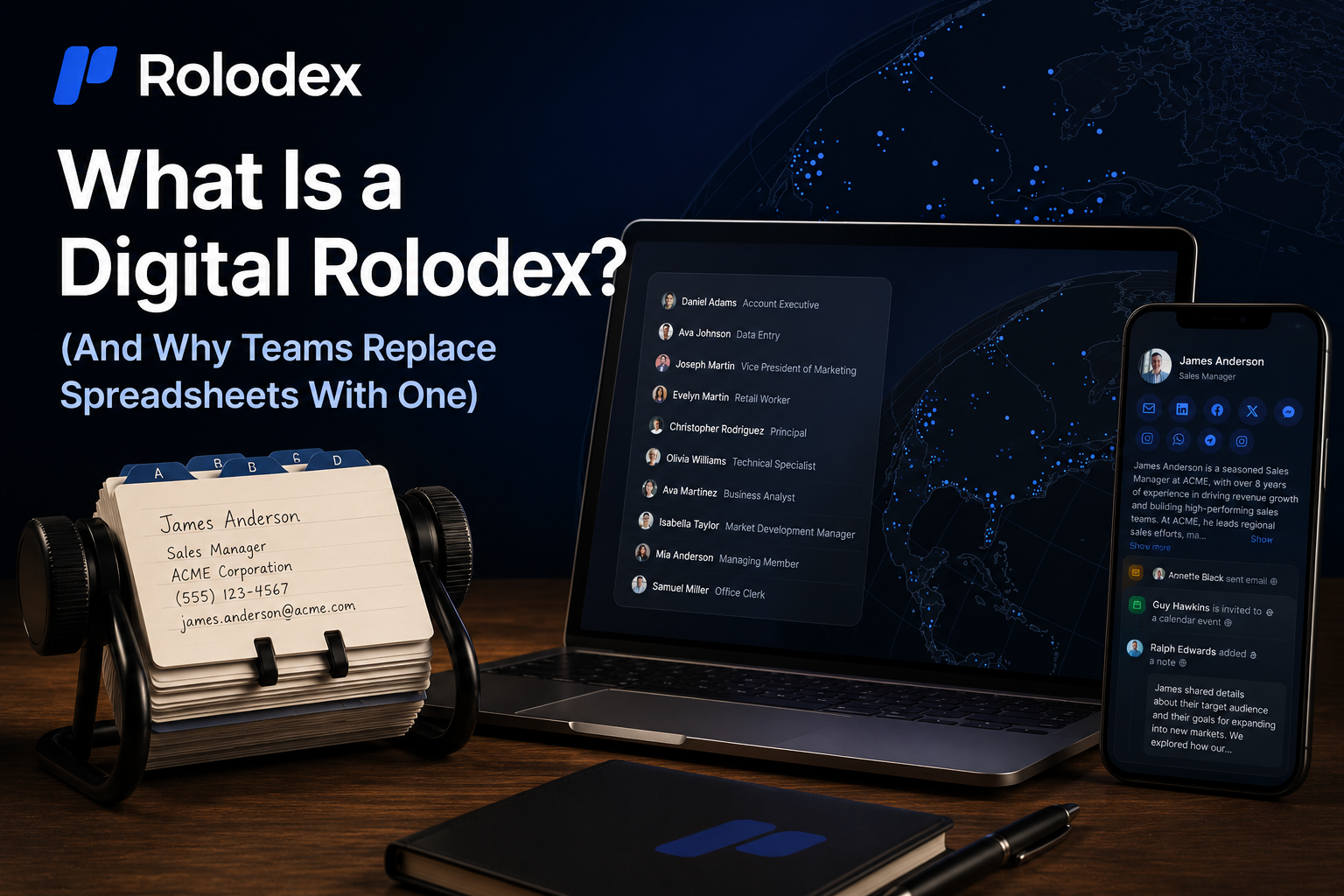
When someone says a person "has a great rolodex," they are not describing a filing system. They mean that person knows the right people, knows them well enough to call, and can act on those relationships when it matters.
The word outlived the spinning card file it came from by several decades, which tells you the idea was the durable part. A digital rolodex is software that organizes your professional contacts, relationship history, and follow-up reminders in one shared place. Unlike a traditional sales CRM, it is built around people rather than pipeline stages. Rolodex CRM is built on this model: a relationship intelligence platform for teams that manage networks, introductions, and long-term professional relationships without a formal sales process underneath them.
You will also see it called an electronic rolodex, an online rolodex, or a virtual rolodex. The terms overlap, and the differences between them are mostly historical.
What does "rolodex" mean?
The original Rolodex was a rotating card file that sat on a desk. Each card held one contact: name, company, phone number, and whatever the owner had written in the margin about how they knew them. It was organized by one person, for one person, and visible only to them.
When the word moved into everyday business speech, it kept that sense. Rolodex meaning, in business usage, is an organized and usable professional network, one where the context behind each name is preserved and ready to act on. Saying someone has a good rolodex implies real relationship history behind each contact, not a long list of names.
The physical version could not scale. Cards did not update themselves when someone changed jobs. They did not surface who you had not spoken to in six months. And if you left the company, your rolodex went with you.
A digital rolodex solves those problems. The better versions go further: they surface who needs a follow-up, track interaction history, sync with LinkedIn to catch job changes, and let teams coordinate around shared relationships without stepping on each other.
What is a digital rolodex?
A digital rolodex is a shared contact management system built around relationships rather than transactions. Where a sales CRM is organized around deals, a digital rolodex is organized around people. The contact is the center of everything: their history with your team, the notes from past conversations, the next step you need to take, and how often you want to stay in touch.
At a minimum, a good digital rolodex app stores:
Contact basics: name, title, company, email, phone
Relationship context: how you know them, what they care about, why they matter
Interaction history: emails, meetings, calls, notes from previous conversations
Next steps: follow-up tasks, reminders, or a cadence for staying in touch
Company associations: who the contact works with, who else at that company you know
What separates a digital rolodex from a spreadsheet is that the information is active, not static. A spreadsheet tells you who someone is. A digital rolodex tells you what has happened with that person, what is supposed to happen next, and alerts you when a relationship needs attention.
Digital rolodex, electronic rolodex, online rolodex: is there a difference?
Mostly no. The terms get used interchangeably, and they all describe software that replaced the physical card file. The distinctions that do exist are worth knowing if you are comparing tools.
Electronic rolodex is the oldest term. It described the standalone devices and desktop programs that replaced the card file in the 1980s and 1990s: a contact database that lived on one machine and belonged to one person. People still use the phrase to mean any software replacement for the physical Rolodex.
Online rolodex describes where the data lives. An online rolodex runs in a browser rather than installed on a single computer, which means it is reachable from anywhere and, more importantly, can be shared with other people.
Virtual rolodex is the loosest of the four. It sometimes means the software and sometimes means a person's network of contacts itself, as in "she has a good virtual rolodex."
Digital rolodex is the term most used now, and it usually implies the full modern version: cloud-based, shared across a team, with interaction history and follow-up reminders rather than just stored contact details.
The label matters less than one question: is the tool built for one person or for a team? An electronic rolodex that lives on your laptop solves a personal filing problem. A shared digital rolodex solves a coordination problem, which is a different and generally more valuable thing.
How a digital rolodex differs from a traditional CRM
People often reach for a CRM when what they need is a digital rolodex, and find that the CRM is the wrong tool for the job.
Traditional CRMs are built around pipeline stages: lead, prospect, opportunity, closed. They are designed to track a contact's progress toward a transaction. That is useful if you are running a formal sales process with a defined funnel. It is the wrong mental model for most professional relationships, which do not move through a funnel at all.
An advisor relationship does not have a close date. An investor you want to stay connected with is not a prospect. A partner you collaborate with periodically does not fit into a pipeline stage. When you force those relationships into CRM fields designed for sales, the system fights you every time you try to use it.
A digital rolodex is organized differently. There is no pipeline. There are people, there is context about those people, and there is some way to make sure you stay in touch. The structure is lighter and the system fits more kinds of professional relationships.
This is why teams that have tried a traditional CRM and found it too heavy tend to gravitate toward a digital rolodex instead. The overhead of maintaining a CRM for non-sales relationships is high. For a direct comparison, see Rolodex vs Salesforce or Rolodex vs Attio.
What a good digital rolodex app actually does
The features that matter depend on what you are using it for, but a few capabilities separate the useful apps from the ones that look good in a demo and then get abandoned.
Shared visibility across the team. A rolodex stored in one person's desktop app is just a digital version of the old problem. When contact information, notes, and relationship history live in a shared workspace the whole team can see, you get a different kind of value: you can see who on your team knows a specific person before you reach out, coordinate on follow-ups, and make sure that context survives when someone changes roles or leaves.
Relationship context on the contact record. Not just a name and email. A note about how you met, what this person cares about, what was said in the last conversation. That context is what turns a list of names into something useful when you are preparing for a meeting or figuring out who to ask for a warm introduction.
Follow-up reminders. The follow-up you intend to send and the follow-up that actually goes out are often different things. A system that surfaces the contacts you have not been in touch with recently, or lets you set a Keep in Touch cadence for your most important relationships, closes that gap. Setting a weekly cadence for the 20 to 50 relationships that matter most is easier when the tool does the reminding.
LinkedIn sync. Contact data goes stale fast. Rolodex CRM syncs with LinkedIn and sends a daily digest when someone in your network changes jobs or gets promoted. Knowing when a contact moves to a new role is often the trigger for meaningful outreach. For where the two tools divide, see Rolodex vs LinkedIn.
Search that actually works. You should be able to type a company name, a tag, or a phrase from a note and surface the right contact quickly. If finding a contact requires browsing through pages of records, the system is not organized well enough to be useful.
Interaction history. When a colleague handled a relationship before you, you should be able to see what was discussed and what was agreed without having to ask them. The history makes the relationship portable across team members.
How teams use a digital rolodex differently than individuals
A single person with a digital rolodex is solving a personal organization problem. A team with a digital rolodex is solving a coordination problem, and the distinction matters.
When three people from your team attend the same conference and come back with 150 new contacts between them, someone has to figure out who owns which relationship, who has already followed up, and what each person learned that the others should know before they reach out. Without a shared system, that coordination happens over Slack and email and eventually stops happening at all.
A shared online rolodex solves this. Each new contact has a clear owner. Notes from the initial conversation are visible to whoever needs them. If a teammate takes over a relationship, the context is already there. There is no six-month rebuild from scratch because the relationship history lived in someone's personal inbox. This is why relationship offboarding gets much easier when contact context lives in a shared workspace.
Teams also use a digital rolodex to surface collective network strength: which companies does your team have relationships with, who is the best person to ask for an introduction, where does your network overlap with a target company's leadership. That kind of visibility is impossible when contacts are split across individual email accounts and personal tools.
What to look for in digital rolodex software
If you are evaluating options, a few things tend to separate the digital rolodex apps that teams stick with from the ones that feel like work to maintain.
It should be easy to keep current. The biggest risk with any contact management system is that it becomes a graveyard of outdated records because maintaining it is too much effort. This was the failure mode of early electronic rolodex software, which stored contacts perfectly well and did nothing to keep them accurate. The best ones make it easy to add context as you go: a quick note after a meeting, a tag change when someone's role shifts, a reminder set in 30 seconds. If logging a conversation requires navigating three screens, it will not happen. Keeping your contact database clean takes about 30 minutes a month when the tool makes it easy.
It should support your team, not just you. If the tool only works well for one person, it is not a shared system for your team. Look for shared workspaces, visible ownership, and the ability to see interaction history across teammates.
It should not require a CRM administrator. A digital rolodex should be lightweight enough that anyone on the team can use it without training or a dedicated ops person to maintain it. If setup requires significant configuration and ongoing maintenance, it is probably a CRM in disguise.
It should connect to the tools you already use. Your contacts come from LinkedIn, email, calendar, and inbound forms. A tool that connects to those sources is more useful than one that requires manual entry. This is the clearest practical gap between an online rolodex and the offline electronic rolodex software it replaced: records stay current without anyone maintaining them.
Frequently asked questions
What does rolodex mean?
In business usage, a rolodex means an organized professional network with real context behind each contact, not just a list of names. The term comes from the Rolodex rotary card file introduced in the 1950s, where each card held one contact's details plus handwritten notes. Saying someone "has a good rolodex" means they know the right people well enough to act on those relationships.
What is the meaning of a rolodex in business today?
The physical product is largely gone, but the meaning transferred to software. A rolodex in business today refers to a digital system that holds contacts, relationship history, notes, and follow-ups in one place. For teams, it means a shared version of that: a network everyone can see and use, rather than one person's private card file.
What is an electronic rolodex?
An electronic rolodex is software that replaces the physical Rolodex card file. The term dates to the desktop contact managers of the 1980s and 1990s, which stored names, companies, and phone numbers on a single computer for a single user. Modern equivalents are usually called a digital rolodex or an online rolodex, and they differ in two ways that matter: they run in a browser so the data is reachable from anywhere, and they can be shared across a team so relationship history does not leave when a person does.
What is Rolodex CRM?
Rolodex CRM is a relationship intelligence platform that helps teams organize professional contacts, track relationship history, and stay in touch with the people who matter to their work. It is not a sales CRM. There is no pipeline, no deal stages, and no lead scoring. It is a shared network for founders, operators, investors, consultants, and BD teams whose work depends on maintaining relationships rather than closing transactions.
Is Rolodex CRM a sales CRM?
No. Rolodex CRM is built for relationship management, not pipeline management. It does not include deal stages, revenue forecasting, or lead routing. Teams that run a formal sales process with quota tracking typically need a sales CRM like Salesforce or HubSpot. Rolodex CRM is for the relationships that exist outside that structure: long-term contacts, referral networks, strategic partners, and professional relationships that matter but do not belong in a sales funnel.
How much does Rolodex CRM cost?
Rolodex CRM is $29 per user per month billed annually, or $39 per user per month billed monthly. There is a 7-day free trial and no credit card is required to start. See pricing for current details, or compare against sales CRMs in Rolodex vs Salesforce.
Who is Rolodex CRM built for?
Rolodex CRM is built for teams where managing professional relationships is the core work: founders and operators who want their team's network in one shared place, venture capital and private equity teams tracking portfolio relationships and deal sources, consultants and advisors who drive revenue through referrals, and business development leads who work through long-cycle relationship building.
Does Rolodex CRM sync with LinkedIn?
Yes. Rolodex CRM syncs with LinkedIn and sends a daily digest of job changes and promotions across your team's network. When a contact moves to a new role, that update surfaces in Rolodex automatically. A tool that does not surface those changes passively requires you to monitor LinkedIn manually, which most teams do not do consistently.
A digital rolodex built for teams
Rolodex CRM is built around the insight that relationships are a team asset, not an individual one. Contacts, notes, interaction history, follow-up tasks, and Keep in Touch cadences all live in a shared workspace where the whole team can see them, contribute to them, and act on them.
It is not a sales CRM. There is no pipeline, no deal stages, no lead scoring. It is a shared network for teams that manage relationships as a core part of their work: founders, operators, investors, consultants, BD teams, and anyone else whose work depends on staying meaningfully connected to the right people.
If you are choosing a digital rolodex for a team rather than for yourself, that shared workspace is the difference that matters. For the full guide to how teams structure their shared network, see best practices for managing your network with Rolodex. To try it with your team, start a free trial and connect your contacts in a few minutes.