How to Turn Job Changes into Warm Outreach Opportunities
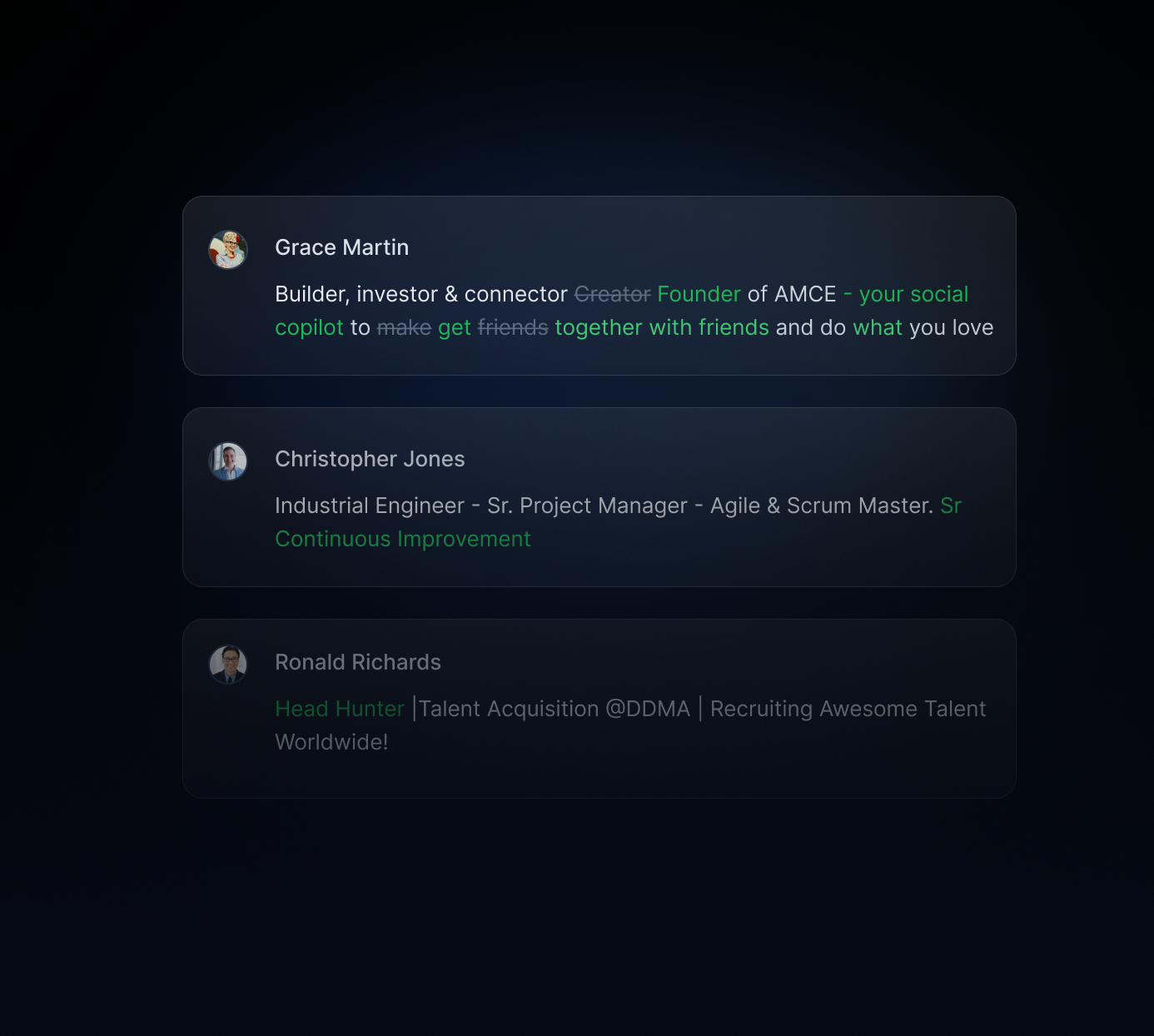
LinkedIn is a firehose. Job changes, promotions, new-company announcements, important signals get buried under hundreds of reactions before you notice them. That's why Rolodex monitors your team's first-degree connections and sends a job change alert the moment a contact updates their title. It turns noise into a short, actionable queue so you can reach out while the news is fresh and the door is open.
Job change outreach works because of timing, not just intent. A message that lands within a few days of a career move gets three to four times the response rate of the same message sent cold a month later. The career move is the reason; your outreach is the natural response. This guide covers how to track job changes across your team's network, how to pair them with warm introductions for the best conversion rates, and four copy-paste outreach templates for every scenario.
How one job change alert became three meetings
Monday morning. Nora, a Partnerships Lead, opens Rolodex and sees three job change alerts:
Ibrahim → VP, Growth at Acme (strategic ICP)
Maya → Director, RevOps at Northstar (active opportunity last quarter)
Jonas → Head of Product at Nova (alumni connection)
Nora triages in two minutes.
For Ibrahim, Rolodex shows that her colleague Leo has a strong connection (weekly emails last year). She asks Leo for a double opt-in warm introduction. Meeting booked for Thursday.
For Maya, Nora sends a personal note referencing last quarter's pilot and attaches a one-page outcomes summary to Maya's contact profile. Maya replies the same day: "Let's revisit next sprint."
For Jonas, Nora uses Map View to see that he's in Copenhagen during her trip next week. She invites him to a small product dinner. He accepts.
Three job change alerts, three warm starts, none of which would have happened if the signals had been lost in the LinkedIn feed.
Why job changes are the highest-signal outreach moment
Not all outreach moments are equal. Job changes sit at the top of the list because they combine genuine reason to reach out with a psychological window when the contact is actively thinking about what they want to do next.
New role, new mandate. When someone steps into a fresh seat, they are surveying tools, auditing vendor relationships, and looking for quick wins to establish credibility. They are more open to new conversations in the first 90 days than at almost any other point in their tenure. A well-timed note that connects to their new priorities lands as helpful, not intrusive.
Promotions create use. More influence often means more budget and more authority to make decisions. Congratulating someone on a promotion and aligning with the outcomes they will be measured on is both genuine and strategically smart. Promotion outreach that arrives within the first week of the announcement gets a response rate that cold outreach cannot approach.
New company, new stack. When someone switches companies, they are rebuilding vendor relationships from scratch. If you have helped them before, this is the moment to re-establish context and ask for an introduction to the right stakeholders at their new organization. The career change is the reason to reconnect; a warm introduction request makes the conversation easy for both of you.
Social momentum. Job change posts get engagement. A timely message feels natural because it arrives while the news is fresh, not months later when the moment has passed.
The key variable is speed. A job change outreach message that lands within three to five days of the announcement converts significantly better than the same message sent two weeks later. Tracking job changes systematically, across your whole team's network rather than just your own LinkedIn connections, is what makes speed possible at scale. Signals like job changes and funding rounds are covered in full as part of the broader trigger landscape.
Why warm introductions beat cold outreach when someone changes jobs
A job change gives you a credible reason to reach out. A warm introduction gives you a trusted path in. Combined, they are the highest-conversion pattern in relationship-based outreach.
Warm introductions work because they transfer credibility. A mutual contact vouches for you, compressing the trust-building steps that consume the first half of most cold calls. When someone is new to a role and still building their internal picture, a warm introduction from a person they already trust carries outsized weight.
Relationship intelligence is what makes this scalable. In Rolodex, each job change alert shows you who on your team has the strongest connection to that contact, the colleague who worked with them, the advisor who knows them, the investor who has been following their career. You route the warm introduction request through the strongest tie, not the first person who comes to mind.
In practice, once a job change alert fires:
Open warm paths to see colleagues, advisors, or investors with meaningful connections to the contact
Request a double opt-in warm introduction with a short forwardable note so the introducer can share it without rewriting anything
Track the motion in Board View: Alerted → Reached Out → Intro Sent → Meeting → Outcome
Attach context to the contact profile, a relevant case note, a deck, a prior conversation summary, so any teammate can follow up with full context
The complete warm introduction guide covers the double opt-in process, forwardable email templates, and how to close the loop after the meeting.
Job change outreach templates for every scenario
Keep messages short, specific, and tied to the new mandate. Personalize one line, the team, the market, the known initiative, so it does not read as a mail merge.
Promotion outreach, congratulate and align
Subject: Congrats on the new role, {{First}}
Congrats on the move to {{New Title}} at {{Company}}, well deserved.
>
If {{owning area}} is on your plate this quarter, happy to share what {{peer company/industry}} did to {{outcome}} in under 30 minutes. Up for a quick chat next week?
> >, {{You}}, {{Role}}
Lateral job change, continuity and quick win
Subject: Quick win idea for {{New Team}}
Saw you shifted into {{New Team}}, nice! Since you already know {{short context}}, I can send a two-slide summary of how teams like {{peer}} used {{your approach}} to {{metric}}.
>
Want me to share?
Career change to new company, stakeholder map and warm introduction
Subject: Welcome to {{New Company}}
Congrats on joining {{New Company}}. We've helped {{peer logos/vertical}} accelerate {{outcome}} in the first 90 days.
>
If you're mapping stakeholders, I can suggest who typically owns {{problem}} and share an org-based checklist. Want me to send that?
LinkedIn DM variant (ultra-short):
Congrats on {{New Title}} at {{Company}}! If {{area}} is on your plate, happy to share a two-minute brief on what's working across {{industry}}. Worth a quick look?
Strategic promotion, senior hire with new scope
Subject: Congrats, {{First}}, one idea for Q{{Quarter}}
Congrats on the promotion. Many {{New Title plural}} we work with are focusing on {{two initiatives}} in H{{Half}}.
>
If helpful, I'll tailor a short brief on what's working and the pitfalls to avoid. Interested?
Pitfalls to avoid when following up on a job change
The line between helpful and intrusive is thinner than most people think. These are the patterns that get ignored or, worse, remembered poorly.
Pitching before congratulating. Lead with the milestone, then add value. A message that opens with your offer before acknowledging their news reads as opportunistic. The career move deserves a sentence.
Asking for a meeting without a reason. Tie your ask to the new mandate or a known initiative. "Would love to catch up" is weaker than "if {{area}} is on your plate, I have something relevant."
Forcing introductions. Always use double opt-in so both the introducer and the recipient can consent. A warm introduction that arrives without the recipient's permission is not warm, it is a cold email with a friend's name attached.
Sending the same message to everyone. Segment by scenario, promotion, lateral move, new company, and by function. A promotion outreach for a CFO reads differently than one for a Head of Design. Keeping scenario-specific templates (like the four above) makes this fast without making it generic.
Slow follow-up. Job change outreach has a short window. A message sent 48 hours after the announcement lands in a crowded congratulations queue but still feels timely. One sent three weeks later requires an explanation. If you are tracking job changes systematically with job change alerts, the queue is always short and the timing is always right.
How to make job change outreach a team habit
Job change alerts convert LinkedIn noise into signal. When your system catches a career move and shows you the warmest path into that contact, through a teammate, advisor, or mutual connection, you start more conversations and better ones.
The teams that do this well have three things in place: a shared CRM that surfaces job change alerts for the whole team's network (not just individual LinkedIn connections), a short library of scenario-specific outreach templates, and a Board View pipeline that moves each contact from alerted to outcome so nothing falls through.
The weekly warmth ritual covers how to build this into a team cadence that takes 20 minutes a week. The inputs are job change alerts, Keep in Touch reminders, and a shared contact history. The output is a consistent flow of warm conversations with people who are already open to hearing from you.
Sign up for Rolodex and start turning your team's next job change alerts into meetings.