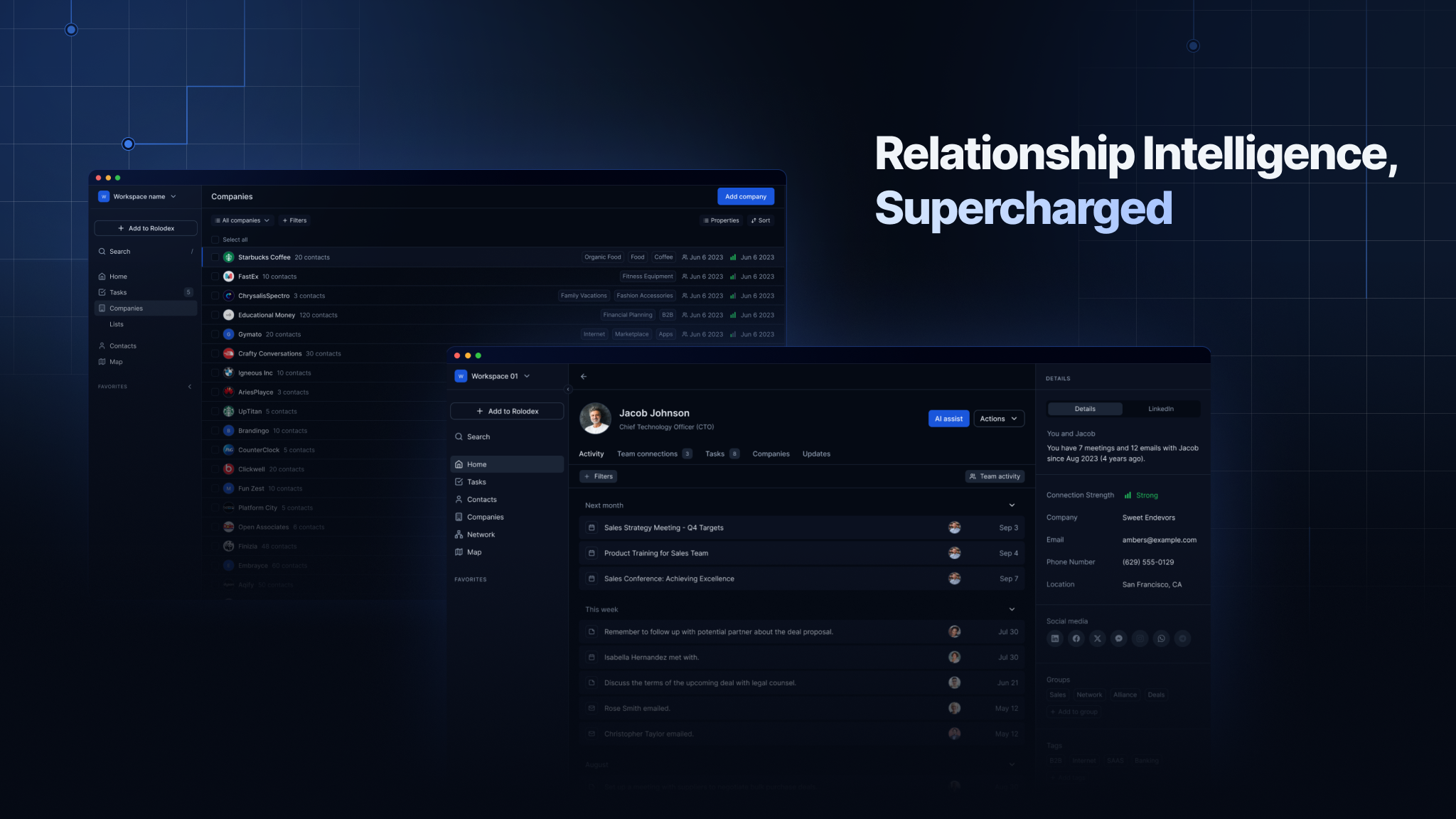
Most teams manage their professional relationships the same way: poorly. Contacts live in individual inboxes. Notes from important conversations end up in someone's personal docs. When a key teammate leaves, the relationship context they built walks out with them. And when a time-sensitive opportunity surfaces, figuring out who on the team already knows the right person turns into a round of Slack messages and a hope someone remembers.
Relationship management software is built to solve this. It is a shared system where a team's contacts, interaction history, and follow-up context live together in one place, visible and accessible to everyone who needs them. Not a sales pipeline. Not a glorified spreadsheet. A tool designed for teams where relationships drive outcomes but a formal sales process is not the primary workflow.
This guide explains what relationship management software does, who uses it, how it differs from a traditional CRM, and what to look for when evaluating your options.
What relationship management software actually does
A contact list tells you who someone is. Relationship management software tells you where you stand with them, and who else on your team knows them.
The difference matters because most of what drives a relationship's value cannot be captured in a name and job title. When did you last speak? Who reached out? What was discussed, and what was promised? Which teammate has the warmer connection and should make the introduction? None of that lives in a phone number or an email address.
Relationship management software captures four things a contact list cannot:
Interaction history: every email, meeting, and LinkedIn connection, mapped to the contact and visible to the whole team
Notes and context: what was discussed, what matters to the person, what the shared history looks like
Relationship status: a sense of how active and warm the connection is right now, and whether it needs attention
Network visibility: which teammates know this person, and how well, so warm introduction paths are visible before anyone sends a cold message
The practical result is a team that can answer "who do we know at that company, and who should make the approach?" in minutes rather than days.
Who uses relationship management software
Relationship management software is most useful when relationships are the core of the work, not a support function for a sales process. The teams that rely on it most:
Business development teams that manage warm introductions, partnership conversations, and deals that move through trust rather than pipeline stages. For these teams, knowing who on the team has a relationship inside a target organization, and how warm that connection is, often determines whether an outreach effort lands or stalls before it starts.
Founders and operators who want visibility into the full reach of their team's network without asking "does anyone know someone at X?" With a shared contact workspace, the answer is searchable rather than conversational. The team's collective network becomes a resource, not a collection of private lists.
Consultants and advisors whose professional reputation depends on who they know and how well those connections are maintained. For independent professionals and small firms, relationship management software replaces the patchwork of LinkedIn, email, and personal notes that most consultants rely on and eventually lose track of.
Recruiting and talent teams that build relationships with candidates well before a role opens. A shared system means candidate context does not disappear when a recruiter changes roles. The relationship history survives the handoff.
Investors and portfolio teams tracking introductions, LP relationships, and deal flow across a team. Context about who has spoken with which founder, and what was discussed, is often worth more than the contact record itself.
What these use cases share: the relationship is the work, not a means to closing a transaction. Software built around pipeline stages creates overhead that gets in the way. Relationship management software is designed to get out of the way.
How relationship management software differs from a CRM
Traditional CRMs are organized around the pipeline. Leads move through stages, deals get scored, and the system generates activity reports to support a forecast. If a team is running a structured sales process with defined stages and revenue targets, that architecture makes sense.
Relationship management software is organized differently. There are no required deal stages, no mandatory pipeline, and no pressure to log activity in a format that supports a revenue report. The focus is on shared visibility into the team's network: who it knows, what has been discussed, and what follow-up is outstanding.
The practical difference is overhead. A CRM asks teams to maintain records in a specific format to serve the pipeline logic. Relationship management software captures context automatically from email and calendar, keeps contact records current through LinkedIn sync, and surfaces what matters without requiring ongoing data entry from the team.
For teams that have looked at enterprise relationship intelligence tools like Affinity and found the price hard to justify, purpose-built alternatives exist at a fraction of the cost. The relationship intelligence tools guide covers the category and compares the main options across use cases.
What to look for in relationship management software
Not all relationship management software is built the same way. The features that matter most for teams managing professional relationships rather than sales pipelines:
Automated contact and interaction capture
Manual data entry is why most relationship systems go stale within weeks. Good relationship management software pulls contacts and interaction history automatically from connected Gmail, Outlook, and LinkedIn accounts. Rolodex does this by default: when a team member sends an email or books a meeting, that activity flows into the shared workspace without anyone maintaining it. Contact records stay current without a data entry workflow.
Shared interaction history
Every touchpoint with a contact, visible to the whole team. Before a meeting, any teammate can pull up the contact profile and see who reached out, what was discussed, and what tasks are still open. Relationship context becomes team-level knowledge rather than individual memory. No one has to ask "wait, did we already follow up on this?"
LinkedIn sync with automatic updates
A contact's title or company change is a natural signal to reach out. Relationship management software with LinkedIn integration keeps contact records current automatically so the team always has an accurate picture of its network. A promotion or a new role shows up in Rolodex before anyone notices it on LinkedIn manually.
Flexible organization with custom fields
The structure should follow how the team actually thinks about its relationships, not a predefined CRM template. Custom fields for relationship stage, investor tier, recruiting status, or deal priority allow teams to organize contacts in ways that reflect their actual workflows. Rolodex also supports contact lists and Board View for teams that want to track relationship warmth or move contacts through a custom workflow.
Follow-up reminders and task coordination
Important connections go cold when there is no system to catch them before drift sets in. Rolodex's Keep in Touch feature surfaces who is overdue for outreach on a cadence each team member sets, automatically. Combined with shared tasks for coordinating who handles which relationship, it is the operational layer that keeps the network active without requiring manual tracking.
How teams put relationship management software to work
A few ways teams use Rolodex day to day:
Pre-meeting preparation. Before a call, pull up the contact profile to see every touchpoint: who reached out last, what was discussed, what was promised, and what tasks are open. Walk into every conversation with full context rather than reconstructing it from scattered inboxes.
Warm introduction routing. Before any outreach push, check the shared workspace to see which teammate already has a relationship with the target. Rolodex's Org Chart feature shows who on the team has connections inside a target company, surfacing warm introduction paths before anyone goes cold. A warm path, when one exists, is almost always worth using first.
Relationship handoffs. When a teammate leaves, their relationship context stays in the shared workspace. Notes, interaction history, and follow-up tasks are accessible to whoever picks up those relationships. Nothing has to be rebuilt from scratch.
Maintaining key contacts over time. For the 30 to 50 contacts that matter most to the team's work, a consistent follow-up cadence prevents important connections from going quiet. A shared view of which relationships are active, cooling, or overdue turns weekly relationship maintenance into a short, structured routine rather than a memory exercise. The guide to keeping track of professional relationships covers how to build this system in Rolodex.
Rolodex is built for exactly this kind of work: a relationship intelligence platform for teams that want shared visibility into their network without the overhead of a sales CRM.
Set up your Rolodex workspace and build a shared relationship management system for your team. Or book a demo to see how other teams use it.